✦ The story
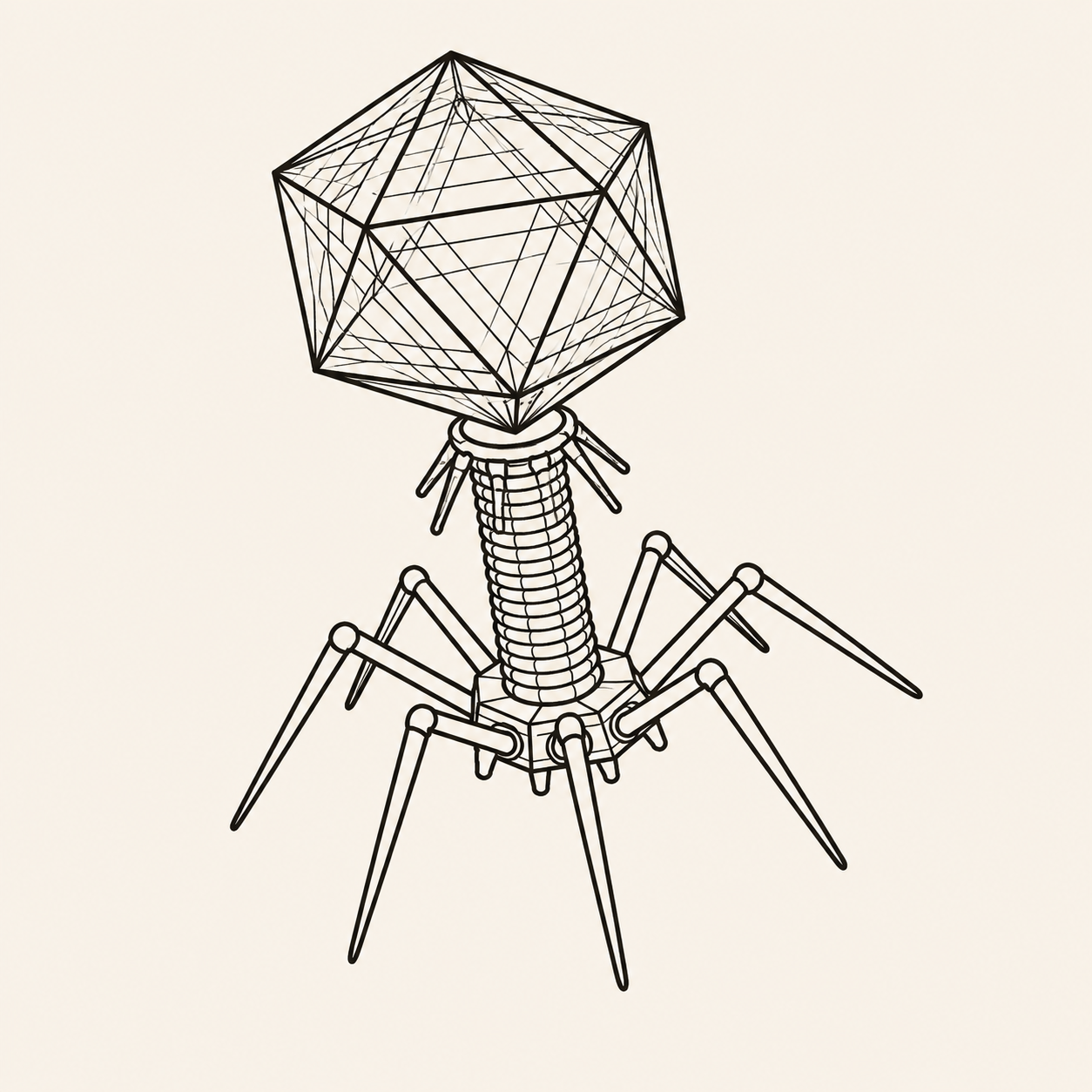
Gabija (named after a Lithuanian goddess of the domestic hearth) is one of the most widespread systems in the anti-phage arsenal: it is found in 8.5% of bacterial and archaeal genomes — more than CRISPR. It combines two proteins: GajA (an OLD-family nuclease + ATPase) and GajB (a UvrD-like helicase). Under normal conditions, GajA is inhibited by cellular ATP that it continuously hydrolyzes. When the phage attacks and depletes the nucleotide pools (greedy viral replication), GajA finds itself de-inhibited and starts degrading the bacterial DNA — the cell self-destructs, the phage doesn't have time to finish. It's an ATP-drop detector that self-triggers.
Discovered 2018
By Doron S., Melamed S., Ofir G., Sorek R. et al. (Weizmann Institute) — *Science* 359 (2018); cryo-EM structure Antine et al. *Nature* 625 (2024)
★ Why we care
Gabija's "metabolic stress sensor → programmed cell death" mechanism is conceptually close to the AMPK → autophagy/apoptosis pathway in eukaryotes. Understanding how GajA sets its activation threshold (how much ATP loss is enough?) informs the design of AMPK inhibitors and anti-cancer metabolic modulators. More directly: as one of the most widely distributed anti-phage systems, Gabija is an excellent candidate for the engineering of probiotic strains resistant to industrial phages.
◇ The detail that lands
The cryo-EM structure solved by the Kranzusch team (Harvard) in 2024 revealed that GajA forms an octamer — 8 subunits assembled in a ring around DNA. Even more surprising: the complex distinguishes circular DNA (plasmids + phages) from linear DNA by topology. When incoming DNA is circular and NTP pools drop, it must be a phage replicating: self-destruction triggers. The bacterium therefore invented a system that doesn't even need to "see" the phage — it just detects the metabolic fingerprint of its replication cycle.