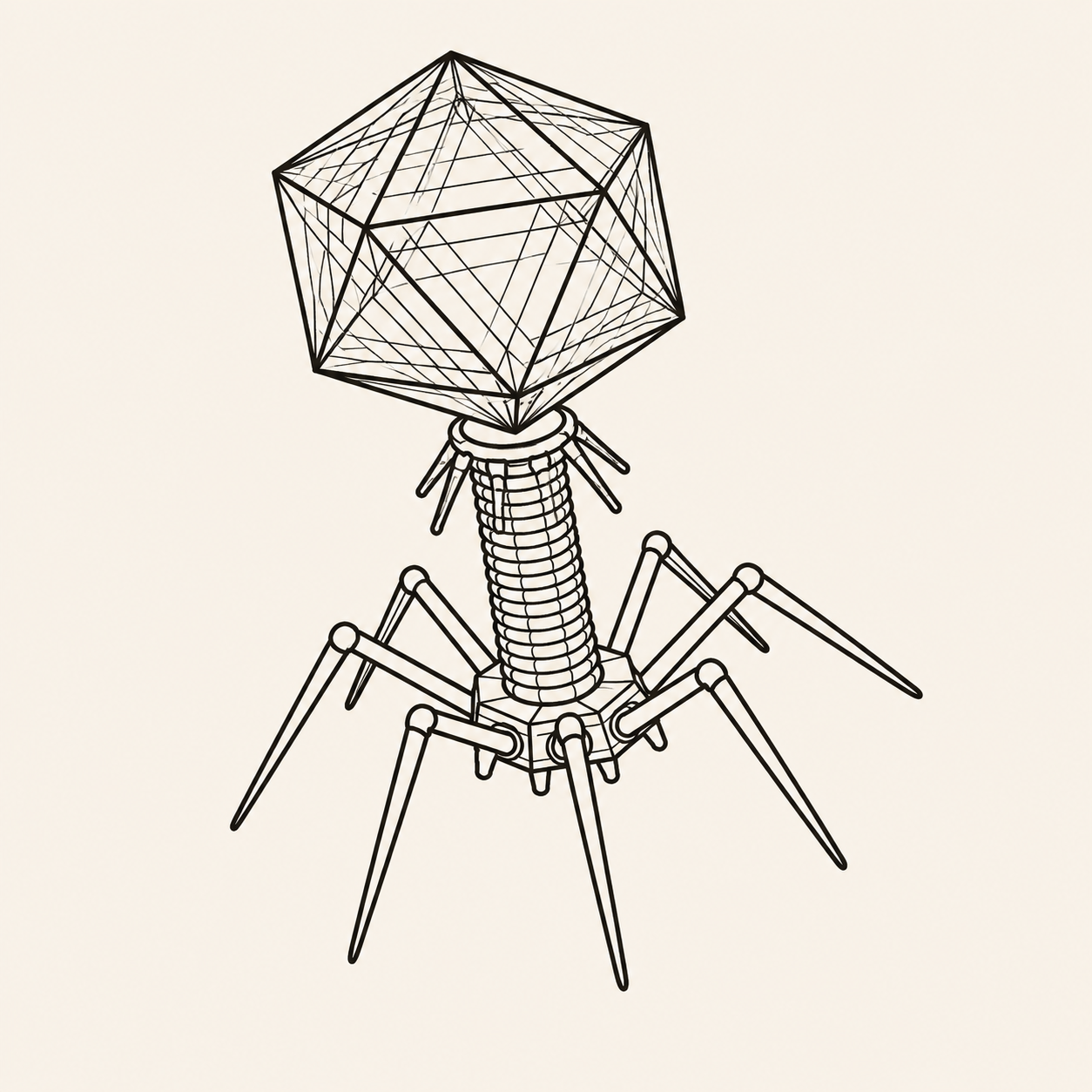
Bactaegion
cabinet / series 2026/2 / 1-01 · CRISPR
EN · FR
next folder
Bactaegion collective mission○ local·0/ 478 206candidate families touched·0therapeutic hypotheses posted·0annotations completed
Canonical sources

Bactaegion does not duplicate any scientific data. Everything comes from public databases.

🔍 Search public databases
📚 Reference bibliography
Mojica F.J.M. et al., Long stretches of short tandem repeats, Mol. Microbiol. 9 (1993).
Barrangou R. et al., CRISPR provides acquired resistance against viruses, Science 315 (2007).
Tesson F. et al., Defense systems census, Nat. Comm. 13 (2022).
DefenseFinder v1.4 · CRISPR-α entry · revised May 14, 2026.
1-01 · canonical · series 2026/2

CRISPR

Clustered Regularly Interspaced Short Palindromic Repeats

The system everyone mistook for genetic junk for 20 years.

Adaptive immunity system based on guide RNAs. It is the most studied bacterial defense. Discovered via palindromic repeats in Escherichia coli in 1987. Mechanism elucidated by Mojica and Barrangou. Major genomic editing tool. However, its human antiviral translational status is limited (non-viable open-source LNP/RNP).

Proteins
1,842
Host
bacteria + archaea
Discovery
Mojica F., 1993
Mechanism
guided RNA/DNA cleavage
Lead DOI
10.5281/zenodo.···
DEFENSEFINDER ENTRY OPEN · DEFENSEFINDER.MDMLAB.FR ↗ frame a hypothesis →
✦ The story

In 1987, a Japanese researcher named Yoshizumi Ishino was sequencing a gene in E. coli and noticed, right next to it, 29 strange repetitive sequences separated by what looked like random DNA. He had no idea what to do with them. He published a footnote. Nobody cared for two decades. In 2005, Francisco Mojica, a microbiologist in Alicante, noticed that the "random" DNA stretches between the repeats were actually fragments of viruses. The bacterium was keeping a vaccination record. In 2007, Rodolphe Barrangou and Philippe Horvath (who were working at the dairy company Danisco to protect yogurt starter cultures) proved that CRISPR was a genuine adaptive immune system — the bacterium memorizes the viruses it has encountered and cuts their DNA if they come back. Five years later, Jennifer Doudna and Emmanuelle Charpentier repurposed this mechanism to edit any genome. Nobel Prize in Chemistry 2020. CRISPR has become such a staple of molecular biology that people forget it is first and foremost a bacterial defense against phages — discovered by accident in the margins of a paper nobody read.

Discovered 1987
By Ishino Y. (Osaka) — sequences; Mojica F. (Alicante) — function; Barrangou R., Horvath P. (Danisco) — experimental proof in 2007; Charpentier E., Doudna J. — editing tool, Nobel Prize 2020
★ Why we care

CRISPR revolutionized biology, but its antiviral profile in humans is limited: we don't know how to efficiently deliver Cas9 into infected cells (no LNP/RNP delivery is viable open-source at broad clinical scale). That is why CRISPR sits in the Bactaegion cabinet as a canonical system (the pedagogical landmark) but not as a priority therapeutic target. The real drug leads are elsewhere — CBASS, Thoeris, RADAR. CRISPR is the mental bridge: once you understand how a bacterium memorizes and slices a virus, you understand why the other systems deserve a serious look.

◇ The detail that lands

The best-known system, *Cas9 from Streptococcus pyogenes, is a dual-scissor endonuclease (HNH + RuvC) guided by an RNA duo (crRNA + tracrRNA). What Doudna and Charpentier did in 2012 was fuse the two RNAs into a single one* (sgRNA, single guide RNA) — the first engineering trick that made it possible to program any target with a few hours of pipetting. A simple fusion of two RNA molecules. That simple, and that is what changed everything.

3D structure · AlphaFold
Cas9 (SpCas9, S. pyogenes) · Q99ZW2
open on alphafold.ebi.ac.uk ↗UniProt entry ↗
Model fetched live from AlphaFold-EBI · CC BY 4.0 · structure never stored by Bactaegion
↗ Cross-reading — Wikipedia
CC BY-SA · live fetch, never stored by Bactaegion

Chargement de l'extrait Wikipédia…

Sources
  1. Mojica F.J.M. et al., Long stretches of short tandem repeats, Mol. Microbiol. 9 (1993).
  2. Barrangou R. et al., CRISPR provides acquired resistance against viruses, Science 315 (2007).
  3. Tesson F. et al., Defense systems census, Nat. Comm. 13 (2022).
  4. DefenseFinder v1.4 · CRISPR-α entry · revised May 14, 2026.
Open leads on CRISPR · 2
Cas13 reconfiguration for pan-RNA virus targeting
pre-clinical 9 contrib.
Cas9 dCas9 + recombinase for HBV integration
in progress 5 contrib.