✦ The story
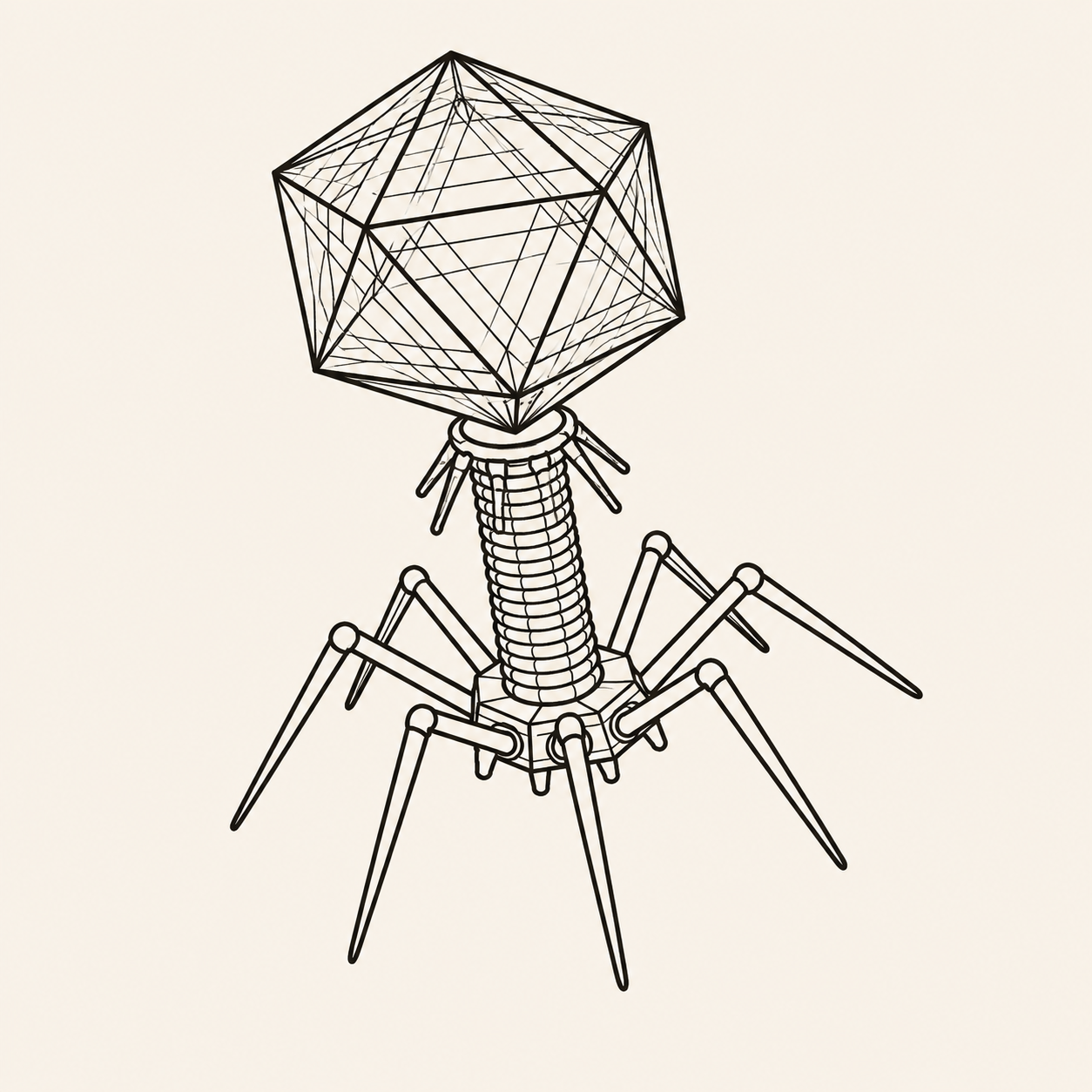
AbiE is one of the oldest characterized anti-phage systems — discovered in the 1990s in industrial lactococci, where phages were causing massive losses in cheesemaking. The mechanism belongs to the broad family of Abi systems (Abiortive Infection): when the phage enters the cell, AbiE triggers the programmed death of the infected bacterium. The cell sacrifices itself before the phage has finished replicating — therefore before the phage releases infectious progeny. Everyone dies except the neighbors. And since a bacterial colony is largely clonal (genetically identical cells), killing one cell to save a thousand is arithmetically a winning trade. It's pure Darwinian altruism, coded in about a dozen genes.
Discovered 1991
By Garvey P., Hill C., Fitzgerald G.F. (University College Cork) — *J. Bacteriol.* 173 (1991), successive toxin-antitoxin characterizations through 2024
★ Why we care
Toxin-antitoxin systems have eukaryotic cousins in the apoptosis and pyroptosis pathways. Understanding how AbiE and its peers detect infection (a metabolic signal, not a viral sequence) and trigger fast, clean cell death sheds light on mammalian innate immunity, where similar switches (caspase-1, gasdermins) sacrifice infected cells to protect the organism. Gasdermin inhibitors in clinical development could benefit from AbiE templates.
◇ The detail that lands
AbiE belongs to the family of toxin-antitoxin systems (TA): the cell continuously produces a toxin (AbiEii) which it neutralizes with an unstable antitoxin (AbiEi). As long as things are fine, the antitoxin is resynthesized faster than it degrades — equilibrium. When the phage attacks and disturbs protein synthesis, the antitoxin collapses first, the toxin is released and kills the cell within minutes. It's a natural "deadman's switch": the poison is leashed by its own degradation, and the slightest metabolic interruption trips the safety.